
Showing posts with label Conductance. Show all posts

Wednesday, December 9, 2015

December 09, 2015

What is Resistance, Conductance And Insulators

Resistance

Resistance may be defined as the property of a substance due to which it opposes (or restricts) the flow of electricity (or electrons) through it.
A resistor is a two-terminal electrical component that implements resistance in a electric  circuit. The resistance (R) of a resistor is defined as the ratio of voltage across it (V) to current through it (I)

rvi

The unit of Resistance

The practical unit of resistance is ohm. A conductor is said to have a resistance of one ohm if it permits one ampere current to flow through it when on volt is impressed across its terminals. For insulators whose resistance are very high, a much bigger unit is used i.e. mega ohm or kilo ohm. In the case of very small resistances, smaller units like milli ohm or micro ohm are used. The symbol for ohm is O.

 Resistivity or Specific Resistance

The electrical resistance of a wire would be expected to be greater for a longer wire, less for a wire of larger cross sectional area, and would be expected to depend upon the material out of which the wire is made. An object of uniform cross section has a resistance proportional to its resistivity and length and inversely proportional to its cross-sectional area
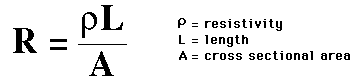
resistivity

The factor in the resistance which takes into account the nature of the material is the resistivity. Although it is temperature dependent, it can be used at a given temperature to calculate the resistance of a wire of given geometry. The inverse of resistivity is called conductivity. There are contexts where the use of conductivity is more convenient.

Temperature Dependence

Resistance of wires, resistors, and other components change with temperature. Resistivity of metals typically increases as temperature is increased, while the resistivity of semiconductors typically decreases as temperature is increased.
Variation of resistance with temperature is given by:

tempres
where  \alpha is called the temperature coefficient of resistance
Based on resistance the substances may be classified as
  • Conductors
  • Semiconductors
  • Insulators

Conductors

Some materials are willing to let a few electrons move from molecule to molecule. Materials that let electrons move through them are called "conductors". It is due to the presence of a large number of free or loosely attached electrons in their atoms. Although some are better than others, most metals are good conductors of electricity. Silver, Gold, and Platinum are very good conductors but are expensive, so they are not often used. Copper and Aluminum are reasonably good conductors and are fairly inexpensive. Thus the wiring in our houses is copper, and the high voltage electric lines that we see crossing the country use aluminum cables.

Insulators

Other substances keep their electrons under very tight control. Materials that do not let electrons move through them are called "insulators". Glass is an example of a type of material that keeps its electrons tightly controlled. Glass is made of silicon molecules, organized very tightly in to crystalline structures. Glass is an extremely good insulator. Many plastics are good insulators too. Plastics are cheap, flexible, and durable

Conductance

 In verse of resistance, unit is Siemens (old unit mho)
Electrical conductivity = s = 1/R

Thursday, October 2, 2014

October 02, 2014

Superconductors


From the name we can guess that superconductors are such conductors which have a very high conductivity (theoretically infinite) or zero resistance.  Usually in all conductors there are obstacles for electrons to flow like, collisions with other atoms of the material, repulsive forces between electrons (as we know like charges repel each other), impurities of the conductors, thermal disturbance created by temperature increase of the conductor etc. In a superconductor these obstacles are eliminated to have a perfect conduction. 

Copper effect: In a superconductive state, electrons are paired together to help each other maintain a significantly higher velocity through the medium.   

 
superconductivity
Superconductivity with years

History: Superconductivity was first discovered in 1911 but until 1986 it was of no use as it was only attainable at 23K (=-250C). In 1986 physicist Alex Muller and George Bednorz increased the temperature to 30K by using Lanthanum barium copper oxide. After few months of the same year professor Paul Chu and Man Kven Wu raised the temperature to 95K using a superconductor of Yttrium barium copper oxide.

Saturday, September 6, 2014

September 06, 2014

Inferred absolute zero temperature:


In a temperature-resistance curve of a metal (such as copper) the resistance gradually increases with the increase of temperature. Temperature has a profound effect on resistance and hence it is important that we determine a method to find the resistance at any temperature within the limit of operation.  Although the temperature-resistance curve is not a straight line, we draw a best fit straight line to find the resistance at normal operating temperature range.


Figure: Temperature-Resistance curve of copper and inferred absolute zero temperature.


Although the actual curve extends to absolute zero (-273.15�C, or 0 K), the straight-line approximation is quite accurate for the normal operating temperature range.

Friday, April 13, 2012

April 13, 2012

Conductors, insulators, and electron Flow

From basic chemistry, we all know that different types of atoms have different energy levels or different degrees of freedom to move around. In metals, the outer shell atoms are loosely bound and they move chaotically in between the space of the atoms. In room temperature they are so loosely bound or unbound that they can move freely and leave their respective atoms. And they can float around the space between the adjacent atoms. So they are called free electrons.

In non-metals or insulators such as glass, the electrons of the atoms are heavily bound or they have a very little freedom to move. But if external energy or force is applied such as rubbing or application of heat then the electrons are excited enough to move and leave their respective atoms and transfer to the atoms of any other material. But they do not have the ability to move between atoms within that material like metals. 

Conductivity is the measure of relative mobility of electrons within a material.


Conductivity depends on various feature of an atom. Such as, the type of the atom in a material, the atomic mass, the formation of the atoms etc. The materials which has a high mobility of electrons are called conductors. On the other hand, the materials with low electron mobility are called insulators.

Few common examples of conductors and insulators are given below:

Conductors:  silver, copper, gold, aluminum, iron, steel etc.

Insulators: glass, rubber, oil, asphalt, fiberglass, porcelain, ceramic, quartz etc.

April 13, 2012

Conductance and the Siemens

When a substance can conduct better, we say that its resistance is less. When it conducts less, we say that its resistance is high. But most of the time electrical engineers don't mention resistance or a material rather they prefer to speak about conductance of a material.

Conductance is the ability of a substance or material to pass electricity. The measure of the opposite of resistance is conductance. Siemens, S is the unit of conductance. When a the resistance of a component is 1 ohm then its conductance is also 1 Siemens. When the resistance is increased to double, the  conductance is decreased to half and vice-versa.

The relation between Siemens and ohms can be written as:

Siemens = 1/ohms, or
ohms =1/Siemens