Showing posts with label Power Systems Engineering. Show all posts

Tuesday, January 1, 2019

January 01, 2019

Electrical Power, Active, Reactive And Reactive Power

Electrical Power Theory And Formula

Electrical energy is the most usable energy in the modern day. Nowadays the whole world is depended on the electrical energy. Electrical power can be transferred easily and also can be distributed easily. In modern days we cannot live without electrical energy. We use electrical power or electrical energy from starting of the day to the end of the day for lighting, heating and for many others works. The conversion of electrical energy into any other energy is very easy. Today we are going to know all the Electrical Power Theory and Formula.

What is Electrical Power

Electric Power Definition

Electrical power is the rate of transfer of electrical energy into other energy per unit time. In other words, it can be called that the electrical power is the rate of electrical energy consumed by load per unit time.
The standard unit of electrical power is Watt.
According to the definition of electrical power, we can say the basic electrical power formula is
Here, W= power in watt
          Q= charge in coulombs
          V= voltage or electrical pressure in volt
          t=time is sec
We know that the rate of flow of charge per unit time is called current(I)
This is the basic formula of electrical power.
According to the OHM's law, we know that V= I*R
So we can represent the electrical power formula by current(I) and Resistance(R) that is,
We can also represent the formula by voltage(V) and Resistance(R) 

                                            W=

V
2


There are two types of electrical power available according to the nature of the Current,
  1. Direct Current (DC)
  2. Alternating Current(AC)
The DC Power and AC Power have different formulas.

DC Power Formula

DC has a constant value that means the magnitude and direction of current do not change with the time. 
Actually, the electrical power depends upon three important things,
  1. Voltage
  2. Current
  3. The angle between voltage and current
The angle between the voltage and current exists when the circuit consists of an inductor or capacitor. If an electrical circuit consists the only resistor then naturally there will be no angle between the voltage and current but if the circuit consists inductor or capacitor there may be some angle between the voltage and current.
In the DC circuit, there is no angle between voltage and current even if the circuit consists Inductors or capacitors because inductance and capacitance effect does not exist on DC supply. 
So the DC power will be the product of the voltage and current.

electrical power formula for DC


So the DC power formula is, 
P = V*I
Here, P= electrical power in watts
         V= voltage in volts
         I= current in amps.

Power Factor: Power factor is a very important thing when we talk about electric power. Power Factor is the cosine of the angle between voltage and current in an electrical circuit. It is defined as cos f or cos(angle). Here f or angle is the angle between voltage and current.

What is the Power Factor of DC?

As we know that the angle(f) between voltage and current in DC circuit is Zero(0). So the power factor of DC will be cos 0 = 1
As the power factor of the DC is 1 (one) it can not affect the power formula and we always say that the DC has no power factor.

Electrical Power Formula For AC

Now let,s know AC power formula. As the magnitude and direction of the current of AC change with time so the electrical power formula is different. If an AC circuit consists the only resistor then naturally the angle between current and voltage will be Zero but if consists inductor or capacitor there may be some angle between voltage and current.
There are three types of AC Power,
  1. Apparent Power
  2. Active Power
  3. Reactive Power
electrical power formula for AC

Apparent Power

The simple product of the voltage and current of an AC circuit is called Apparent Power. But remember that the value of the voltage and current should be RMS value.
The Apparent power is denoted by 'S'
So the formula of apparent power,
 S=Vrms * Irms

The RMS value of the voltage can be found from the equation,  

The RMS value of the current can be found from the equation,

If the AC circuit only consists resistor then the power can be derived by this equation or in other words for pure resistive circuit the apparent is equal to the active power.
The unit of Apparent power Volt-Ampere.

Active Power

It is the power which actually consumed by the AC Load consist of resistance, inductance, and capacitance. It is denoted by 'P'
Active Power takes the cosine of the angle between the voltage and current into account.
So the active power formula is,
P=Vrms * Irms * cos f

f is the angle between voltage and current
The unit of Active power is Watt

Reactive Power

The power dissipated by the circuit element reactance is called Reactive Power. Suppose an electrical AC circuit consists the only resistor then we can say that circuit has not any reactance but if the circuit consists inductance or reactance then the circuit will have reactance.
The reactive power is denoted by 'Q'
The formula of Reactive power is,
Q=Vrms * Irms * Sin f

The relation between Apparent power, active power, and reactive power can be written as below

Electrical Power Triangle

The electrical power triangle consists,
  1.  Active power in 'X' axis 
  2. Reactive power in 'Y' axis
  3. Apparent power in 'Z' axis
electrical power triangle


Saturday, January 2, 2016

January 02, 2016

Hydroelectric Power Plants - Advantages, Disadvantages

Hydroelectric power plants convert energy available from flowing water into electricity. These power stations are suitable where water resources with sufficient head are available. When water is allowed to flow from the high elevation to a lower elevation, potential energy is transformed into kinetic energy, which is converted into electrical energy by the hydroelectric power plants.
The hydroelectric power plants can be divided into:
  1. Storage based power plants: these are the most common type and can produce electric power in huge quantities. A dam is built across the river bed creating a huge reservoir of water behind it.
  2. Run-off river or diversion power plants: A portion of a river or stream water is diverted to create a difference of elevation. These are small size plants and depend on availability of water for their operation.
  3. Pumped storage power plants: A pumped storage plant operates as a dual action water flow system. When the power demand in a power system is low, a part of energy generated by other power plants in the system is used to pump water from a lower level in front of a dam to a higher level behind the dam. In case of higher electric power demand the water behind the dam is used to produce electrical energy.The major functional parts are explained below. 
Dam or Reservoir
Stops the river's flow and forms a reservoir. The reservoir stores water during rainy seasons. It also helps to maintain a steady water head for the turbine to operate. The water level of the reservoir is called head race.
Tunnel
Tunnel is used to transport water from the reservoir to the generating station. It is normally made of RCC (Reinforced Cement Concrete).
Pen-stock
A penstock is a conduit that takes the water from the reservoir to the powerhouse. It is usually made of steel and is suitable for carrying water at medium to high pressure. For low-pressure penstocks, RCC pipes are also used.
Valve houseThis is a facility to start or stop the water flow into the powerhouse for normal operation and for maintenance.
Surge tank
Surge tank is a small additional storage facility near the powerhouse. When the distance is more, non-uniform water intake to the powerhouse results in water hammering. The surge tank takes the sudden increase of pressure by allowing the water into it, when the water flow is stopped or reduced. Thus the surge tank functions as a pressure regulator in the water line.
Powerhouse
A powerhouse houses the turbine and the generator. The turbine converts the hydraulic energy from flowing water to mechanical energy. The generator, which is mechanically coupled to the turbine, converts mechanical energy to electrical energy. The used water from the turbine is released through the Tail race.
Factors to be considered:
  1. Quantity of water available
  2. Storage facility
  3. Head of water
  4. Accessibility
Advantages of hydroelectric power plants: 
  • No fuel is required for operating a hydroelectric power station. 
  • The generation cost is very low. 
  • Uses simple technology. 
  • Low start up time. 
  • It is a clean source of energy and no pollutants are generated. 
  • Generally hydro plants have longer life compared to other types. 
  • The dam and reservoir serve the purpose of irrigation and flood control also. 
Disadvantages of hydroelectric power plants:
  • It requires large area for installation. 
  • May affect the ecological balance of the area. 
  • High cost of construction. 
  • Long gestation period (time taken to get back returns after making the investment) 
  • The generation is weather dependent.

    Thursday, December 31, 2015

    December 31, 2015

    Smart Grid Technology and Applications - IEEE Xplore

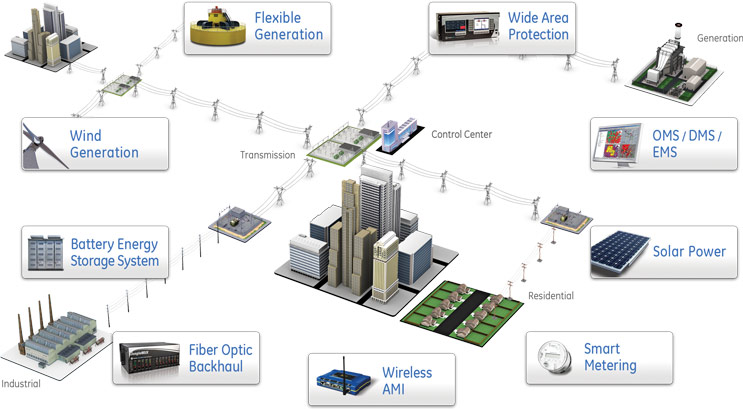
    Smart Grid generally refers to a class of technology being used to bring utility electricity delivery systems into the 21st century, using computer-based remote control and automation. Much in the way that a smart phone these days means a phone with a computer in it, smart grid means computerizing the electric utility grid. They offer many benefits to utilities and consumers - mostly seen in big improvements in energy efficiency on the electricity grid and in the energy users homes and offices.
    Smart power grids are expected to accommodate increasing volumes of renewable energy sources and energy storage systems. Smart grid infrastructure also facilitates the operation of subsystems in is landed modes in cases of contingency. The field opens wide doors for fruitful work of research and development along the axes of system components, operation, restoration, protection, control, planning, design, optimization, forecasting, and scheduling.

    Smart Grid Assembly

    Like the Internet, the Smart Grid will consist of controls, computers, automation, and new technologies and equipment working together, but in this case, these technologies will work with the electrical grid to respond digitally to our quickly changing electric demand. 
    In smart grids, communications between system components represent the backbone of system operation. A huge volume of data will be available at the discretion of the operator covering a number of aspects such as load consumption, generation scheduling, and component loading. Smart grids help improve system operation in terms of reliability, controllability, and optimization. Smart Grid network uses standard communication protocols to ensure compatibility and inter-operability. 
    The network connects substations, distribution grid devices, meters, and in-home devices with the utility's head-end software to provide private communications for utility operations and secure communications to allow consumers to interact with their energy control devices.

    Why Smart?

    It give the consumer the information and tools required to make choices about their energy use. With a smarter grid, you can have a clear and timely picture of how much electricity you use. "Smart meters," and other mechanisms, will allow you to see how much electricity you use, when you use it, and its cost. Smart grid will add resiliency to our electric power System and make it better prepared to address emergencies. A key feature of the smart grid is automation technology that lets the utility adjust and control each individual device or millions of devices from a central location.
    Intelligent capable of sensing system overloads and rerouting power to prevent or minimize a potential outage; of working autonomously when conditions require resolution faster than humans can respond and cooperatively in aligning the goals of utilities, consumers and regulators.

    Efficient capable of meeting increased consumer demand without adding infrastructure.

    Accommodating accepting energy from virtually any type of source including solar and wind as easily and transparently as coal and natural gas; capable of integrating any and all better technologies and energy storage technologies. 

    Motivating enabling real-time communication between the consumer and utility so consumers can tailor their energy consumption based on individual preferences, like price and/or environmental concerns.

    Quality-focused capable of delivering the power quality necessary free of sags, spikes, disturbances and interruptions to power our increasingly digital economy and the data centers, computers and electronics necessary to make it run.

    Resilient increasingly resistant to attack and natural disasters as it becomes more decentralized and reinforced with Smart Grid security protocols.

    Green slowing the advance of global climate change and offering a genuine path toward significant environmental improvement with the improved usage of renewable energy sources.

    Comparison Between Grid And Smart Grid

    Benefits

    The benefits associated with the Smart Grid include:
    • More efficient transmission of electricity
    • Quicker restoration of electricity after power disturbances
    • Reduced operations and management costs for utilities, and ultimately lower power costs for consumers
    • Reduced peak demand, which will also help lower electricity rates
    • Increased integration of large-scale renewable energy systems
    • Better integration of customer-owner power generation systems, including renewable energy systems
    • Improved security

    Micro Grid

    Micro Grid

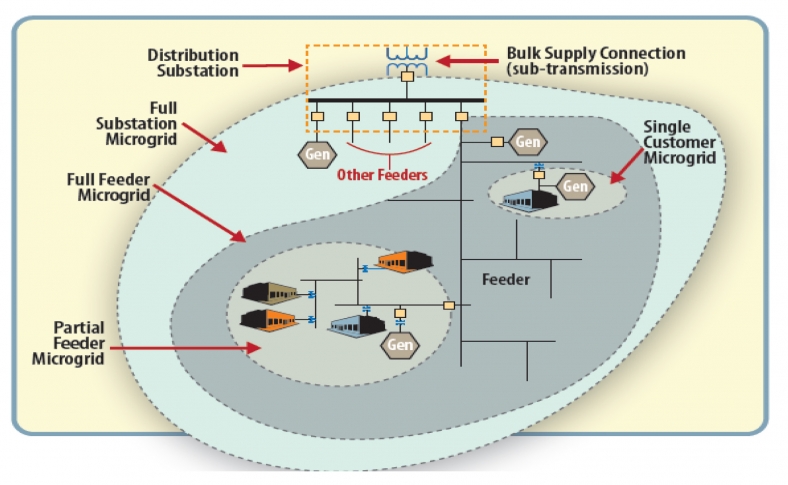
    Micro grids are localized grids that can disconnect from the traditional grid to operate autonomously. They help mitigate grid disturbances to strengthen smart grid resilience, because they are able to continue operating while the main grid is down, and they can function as a grid resource for faster system response and recovery.
    Micro grids also support a flexible and efficient electric grid, by enabling the integration of growing deployments of renewable sources of energy such as solar and wind and distributed energy resources such as combined heat and power, energy storage, and demand response. In addition, the use of local sources of energy to serve local loads helps reduce energy losses in transmission and distribution, further increasing efficiency of the electric delivery system.

    Saturday, December 12, 2015

    December 12, 2015

    Electricity Power Generation, Sources of Energy

    The most common method of generating electrical energy is by means of electric machines known as Generators.  Generators used to generate A.C. electrical power are also called Alternators.  These machines are essentially converters which convert mechanical energy into electrical energy. The mechanical energy required to turn on alternator is supplied by machines or devices called prime movers.  Alternator systems are generally named for their prime movers.

    Sources of Energy

    Selection of a particular type of power plant for an area depends on a number of factors like energy demand, availability of fuel, pollution standards and financial considerations.
    Based on the requirement of fuel, energy sources- are broadly classified as renewable energy sources and non-renewable energy sources.
    Renewable energy sources are considered to be available forever. Examples are hydro energy, solar energy, wind energy, wave energy etc. Non-renewable sources use some fuel like coal, which will be available for a limited period of time only.
    Energy sources like solar energy, wind energy, wave energy, tidal energy etc. are relatively new in bulk electricity- generation and therefore arc called non-conventional energy sources.

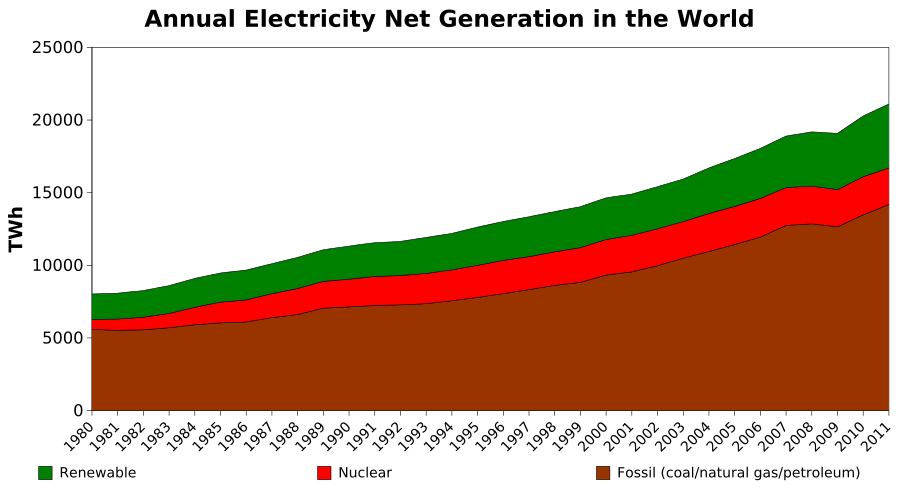
    900px-annual_electricity_net_generation_in_the_world-svg