Showing posts with label Current. Show all posts

Tuesday, December 15, 2015

December 15, 2015

Voltage, Current, Resistance, and Ohm's Law


Ohm's law applies to electric conduction through conductors and may be stated as follows:-
The ratio of potential difference (V) between any two points on a conductor to the current (I) flowing between them, is constant, provided the temperature of the conductor does not change.
In other words
V/I = Constant
V/I = R
Where R is the resistance of the conductor between the two points considered

Put in another way, it simply means that provided R is kept constant, current is directly proportional to potential difference across the ends of the conductor. For a constant value of R, if the value of V is increased, the value of I increases; if V is decreased, then I decreases.  Also notice that if is constant and R is increased, I decreases.  Similarly, if V is constant and R is decreased, I increases.
Figure show the current voltage relationship for R=10 ohm.
Material that obeys Ohm's Law is called 'ohmic' or 'linear'  because the potential difference across it varies linearly with the current. However this linear relationship between V and I does not apply to all non-metallic conductors.

Tuesday, December 8, 2015

December 08, 2015

Voltage, Current, Electro Motive Force (EMF) Relationship

The Voltage is the difference in electric potential between those two points. The difference in voltage measured when moving from point A to point B is equal to the work which would have to be done, per unit charge, against the electric field to move the charge from A to B. The 'Volt' (V) is the unit of voltage. Instrument used for measuring voltage is Voltmeter.
voltage

Potential Difference and Electro Motive Force

To have flow of electrons or electricity between the two ends of a conductor, the difference of electric pressure is necessary. The difference of electric pressure is known as potential difference. Rate of flow of electricity or current strength depends upon the potential difference. Greater the potential difference, the greater will be the current strength, lessor the potential difference, lesser the current strength. No potential difference, no current.

The potential difference is that which causes the current to flow in a closed circuit.

The electromotive force (e.m.f.) of a source is the potential difference between the terminals of the source when no current is drawn from it i.e. when the source is in the open or infinite resistance circuit.
The potential difference is the difference of voltage between the terminals when the load is connected with the source. The unit of potential difference in practical as well as in mks (or SI) system of units is volt.

Are Voltage And Current Related ?

Voltage and current are not the same thing, although they are closely related. In simple terms, Voltage causes Current. Given a Voltage and a path for the electrons, current will flow. Given the path, but no Voltage, or Voltage without the path, there will be no current.

Tuesday, December 1, 2015

December 01, 2015

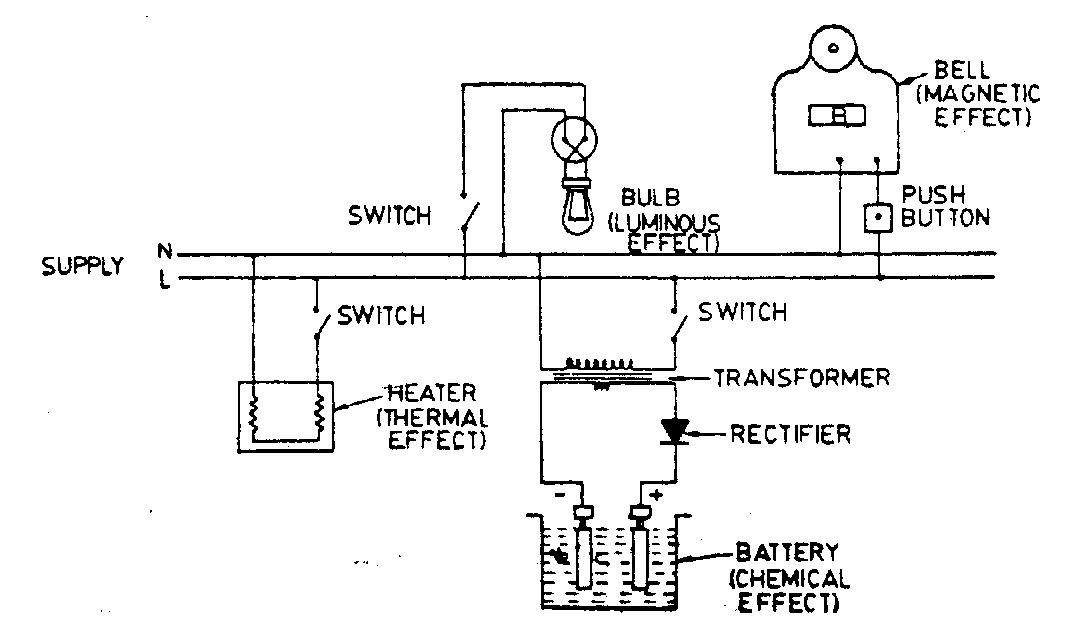
Effects of Electric Current - Magnetism and Electricity

Thermal Effect
The current flowing in a conductor always causes the conductor to become hot.  This is known as thermal effect as in an electric heater or electric iron.
Luminous Effect
When the temperature of the conductor is increased sufficiently, then light is emitted.  This is known as the luminous effect as in an electric bulb (i.e. incandescent lamp).  Light can also be obtained by ionizing the mercury or sodium vapor as in as fluorescent tube and sodium vapor lamp respectively.

effectsofelectricity

Chemical Effect
When current flows through a certain liquid chemical known as electrolyte, Chemical changes occur in the liquid and in metals immersed in it and connected to the circuit.  This is known as the chemical effect as in battery charging.
Magnetic Effect
The current flowing in a conductor always produces a magnetic field around the conductor.  This is known as the magnetic effect as in an electric bell or electric motors.
December 01, 2015

Fundamentals of Electricity - Basic Concepts

Electricity is the modern friend of man.  It has become a part and parcel of our daily life.  Where ever we may cast our eyes, we find the achievements and attainment of electricity.  It has really made the life of a person quite comfortable.
Talking on telephone with friends and relatives, watching football match on T.V. effective & efficient cooling of Air conditioners, cooking the food by cooking range, heating the food by microwave oven, quick ironing of clothes with electric iron etc have been possible only due to our modern friend electricity.
Electrical Engineering

An electric bulb, an electric bell and a room heater, all require electric current for their operation but current produces different effects in each case. Therefore before numerating the various applications of electricity, it is essential that we should consider the various effects of electric current.The electrons in the outermost orbit are known as valence electrons.  In some elements these valence electrons are loosely bounded to their nucleus and can he dislodged by some means or the other.  Such electrons are also known as free electrons. Certain materials such as Copper, Aluminium have many free electrons.  These free electrons used to move haphazardly in all directions from atom to atom in the material. If, however the free electrons can be caused to move through the material in the same general direction, the net electrons movement is the flow of electricity and is called an electric current.

Friday, April 13, 2012

April 13, 2012

Ideal Voltage and Current Sources

Ideal Voltage Sources


An electrical device which can generate prescribed voltage irrespective of the current supplied to other elements is called an ideal voltage source. The ability to provide constant voltage will not be harmed by any other means like heavy load. Since load always destabilizes voltage sources and at full load no source can produce prescribed voltage so ideal voltage sources are imaginary. Ideal voltage sources are not available in real world. We use this idea of Ideal voltage source to make comparison among other voltage sources. 


In summary we can say, An ideal voltage source is an electric device which maintains a constant voltage whether we change the load or not, or we can say irrespective of the current flowing throw it. The amount of the current supplied by the source depends on the circuit connected to it.


Ideal Current Sources


An electrical device which can generate prescribed current irrespective of the circuit or other elements connected to it, is called an ideal current source.To maintain a constant current the voltage in the circuit will vary. Thus it will produce arbitrary voltage across its terminals. The figure below shows symbol of ideal current sources. 


We can say: An ideal current source maintains a prescribed or constant current irrespective of the circuit connected to it. The circuit connected to the ideal current source determines the voltage generated.

 
April 13, 2012

Dependent (Controlled) Sources

Usually the voltage and current sources have the ability to generate specific voltage or current irrespective of any other element in the circuit. So, they are not dependent on any other circuit element and termed  as independent sources.

But the sources, whose output (current or voltage) is a function of some other voltage or current at a point in a circuit, are called dependent (or controlled) sources.

Dependent sources are represented by a symbol in the shape of a diamond. The symbol is shown in the figure. In the following table the relationship among source voltage and the dependent voltage or the source current or the dependent current is shown:


April 13, 2012

Voltage and Current:

Like static electricity, electrons can be motivated to flow through a conductor. The force is the same force manifested in static electricity.

When electrons moves through a closed path then it is called a circuit. When the specific potential energy is different in two location of a circuit then electron flow from high potential to low potential. The measure of specific potential energy (potential energy per unit charge) between two locations at a circuit is called voltage. Voltage is an expression of potential energy. Hence it is always relative between two locations, or points. Most of the time it is called a voltage "drop."

 
If we connect a voltage source to a circuit, then because of the potential difference, electrons will flow uniformly through that circuit. This uniform flow of electrons is called current.


The amount of current is always same at a single loop circuit. The current will not change anywhere in the circuit. But the voltage drop will be different. 


In a broken circuit, where there is a voltage source connected, then the full voltage of that source will appear across the points of the break.


The + sign shows the positive polarity in a circuit and the - sign shows the negative polarity. This convention is also relative.