Showing posts with label Magnetism. Show all posts

Monday, January 11, 2016

January 11, 2016

Electromagnetic Induction and Faraday Law of lnduction

Electromagnetic induction is the process by which an e.m.f is induced in a conductor whenever there is change in the magnetic flux linking the conductor.


Consider a coil with few number of turns of insulated copper wire and connected to a galvanometer as follows in Figure. When a permanent magnet is moved towards the coil, the pointer of the galvanometer is deflected, thereby indicating the flow of current. This current is due to e.m.f induced in the coil. If movement of the magnet is stopped, though the flux is still linking the coil, the deflection of the galvanometer is reduced to zero, since there is no change in flux.
Now repeat the above process by a coil having more number of turns, or with a stronger magnet or move the magnet with greater speed. In each case greater deflection of the pointer of galvanometer will be observed.
An e.m.f will also be induced in the coil if the magnet is stationary and the coil is in motion.
E.M.F Induction

As explained above when a magnet approaches a coil, e.m.f is induced in it. But the direction of induced current in the coil is such that it develops polarities which oppose the motion of the magnet i.e., when north pole of the magnet is moving towards the coil then the left face of the coil becomes N pole. Thus a force of repulsion will exist between the magnet and coil. When North pole is moving away from the coil the left face of the coil becomes S pole. Thus a force of attraction will exist between the two. In both cases we observe that the effect of induced current is to oppose the motion. If, on the contrary, induced current flows in a direction that the left coil face becomes S pole when north pole magnet is moving towards the coil then due to attraction between unlike poles the magnet will be automatically moving towards the coil. Hence the direction of induced current in the coil is such that it opposes the cause by which it is being induced.

From the above discussion we conclude that
i) E.m.f is induced in a coil only when there is change in the magnetic flux linking the coil.
ii) The magnitude of induced e.m.f depends upon the number of turns of the coil, strength of the magnetic field and the relative motion between the magnetic field and coil.
iii) The direction of induced e.m.f is such that it opposes the cause producing it.

The above conclusions have been incorporated into the various laws of electromagnetic induction explained in the following paragraphs.

Faraday's Laws of Electromagnetic Induction

Whenever flux linked with a conductor changes, an e.m.f will be induced in that conductor.


The second law states that magnitude of the induced e.m.f is directly proportional to the rate of change of flux lined with the conductor.

Assuming that the coil has N number of turns and the flux linked with the coil changes from the initial value f1 wb to the final value f2 wb in t second, then the flux linked is the product of the number of turns and the flux linked with the coil.
Then,
We have initial flux linked = Nf
 Final flux linked = Nf2

Dynamically Induced e.m.f

Whenever the conductor of length l is made to move in the magnetic field of flux density B with the velocity v, then e.m.f. so induced in the conductor is known as dynamically induced e.m.f. The conductor moves at an angle q with the direction of the lines of force then the induced e.m.f is 
e=Blv sin q
Where as 
B = flux density in wb/m2
l = length of conductors in meter
v = velocity of the conductor
f = the angle between the conductor and the line of force

If the circuit of the above induced e.m.f. is completed, a current will flow, which can be called as induced current.

Thursday, December 17, 2015

December 17, 2015

Magnetism, Magnetic Flux and Magnetic Materials

Any body which posses the power of attracting pieces of iron (magnetic material) is known as a magnet and the property of the body by virtue of which this attraction takes place is known as magnetism.
Since lode stone possesses the magnetism when it is taken out from the earth, it is called the natural magnet. Commercial magnets are made artificially from iron and steel or alloy materials and they are called artificial magnets. Artificial magnets can be made either by rubbing a piece of iron or steel with the load  stone or by passing a electric current through a coil over the piece of iron or steel. Magnets prepared by the second method are called electro magnets.
Magnets can be classified as being permanent or temporary, depending on their ability to retain magnetism. The material retain their magnetism for a long time after removal of magnetization force are called permanent magnets( e.g.: alnico) they are used in small dc motors, measuring instruments, speedometers, speaker etc. the substances which loses most of their strength when the magnetizing force is removed is termed as temporary magnet material( soft iron materials)

Magnetic Poles

Magnets have two opposite kinds of magnetism or magnetic poles, which attract or repel each other. One of the magnetic poles is called North Pole and the other South Pole. Similar poles repel each other and opposite poles attract each other. The force between two magnetic poles is directly proportional to the product of their pole strength and inversely proportional to the square of the distance between them.
Para-magnetic materials: they are not strongly attracted by the magnet. E.g.: aluminium, tin, platinum, manganese etc. their relative permeability is small but positive
Dia-magnetic materials: they are repelled by the magnet. E.g.: Zinc, Mercury Lead, Sulphur, and Copper etc. their relative permeability is slightly less than unity.Ferromagnetic materials: they are strongly attracted by the magnet. E.g.: Iron, Steel, Nickel some of their alloys etc. their relative permeability is very high. They are further classified in to two:
Soft magnetic materials do not retrain their magnetism for any appreciable time after the magnetizing force has been removed. They have very high relative permeability. E.g.: soft Iron, silicon steel soft ferrites etc.
Hard magnetic materials retain their magnetism for a long time. They are used for making permanent magnets and hence called permanent magnetic materials. E.g.: carbon steel, cobalt steel, alnico, hard ferrite etc.

Magnetic Field and Properties

The space around the poles of a magnet is called the magnetic field and is represented by magnetic lines of force. The total number of lines of force surrounding a magnet is called the total magnetic flux (f)The SI unit of magnetic flux is Weber (Wb)
The flux passing through a material or a plane at right angle to the direction of flux per unit area is called magnetic flux density. The unit is Tesla.
B = f/A
Magnetic Field Strength designated by H at any point is defined as the force experienced by a u\nit north pole when placed at that point.
Magnetic potential at a point in the magnetic field is defined as the work done in moving a unit north pole from infinity to that point against magnetic force.
Magnetic permeability is the measure of the ability of a material to support the formation of a magnetic field within itself.
B = mH
m = m0mr
where, mis called the permeability of free space, and is equal to 4x 10⁻⁷ H/m. and m= m/mis called the relative permeability.
The reciprocal of magnetic permeability is magnetic reluctivity.
Magnetic susceptibility is defined as the ratio of intensity of magnetization to the magnetizing force and is represented by c.

Tuesday, December 1, 2015

December 01, 2015

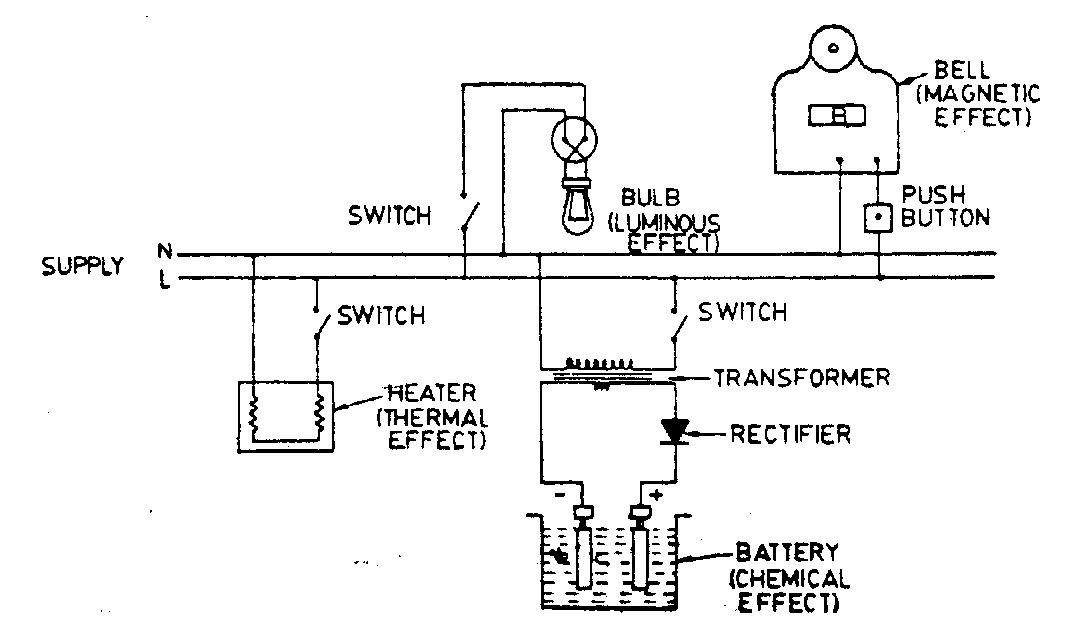
Effects of Electric Current - Magnetism and Electricity

Thermal Effect
The current flowing in a conductor always causes the conductor to become hot.  This is known as thermal effect as in an electric heater or electric iron.
Luminous Effect
When the temperature of the conductor is increased sufficiently, then light is emitted.  This is known as the luminous effect as in an electric bulb (i.e. incandescent lamp).  Light can also be obtained by ionizing the mercury or sodium vapor as in as fluorescent tube and sodium vapor lamp respectively.

effectsofelectricity

Chemical Effect
When current flows through a certain liquid chemical known as electrolyte, Chemical changes occur in the liquid and in metals immersed in it and connected to the circuit.  This is known as the chemical effect as in battery charging.
Magnetic Effect
The current flowing in a conductor always produces a magnetic field around the conductor.  This is known as the magnetic effect as in an electric bell or electric motors.